Most engineering students treat seminar topics as a formality. They pick something quickly, prepare a presentation, deliver it, and move on. The problem with this approach is that it wastes a valuable opportunity. A seminar topic, if chosen correctly, can become the foundation for your first real project, your resume, and even your first job conversation.
The difference is not in the topic itself, but in how you choose it!
Here is a structured way to think about that choice. Instead of randomly selecting something that sounds impressive, you will learn how to align your seminar topic with your career direction.
Step 1: Define Your Goal
Before you even start browsing topics, you need clarity about what you want. Without that clarity, every topic looks equally good or equally confusing.
Most students fall into one of three broad directions. Some want a job immediately after graduation, especially in software or IT roles. Others are inclined towards higher studies or research. A third group simply wants to complete the seminar requirement with minimal effort.
Each of these paths demands a different kind of topic.

If your goal is to get a job, your topic must lead to something practical. It should allow you to learn a tool, build something small, or demonstrate a skill that companies actually look for. For example, instead of choosing a broad topic like artificial intelligence, you could narrow it down to building a simple chatbot using Python. That gives you something tangible.
If you are planning for higher studies, depth matters more than application. A topic like ethical implications of artificial intelligence or optimisation techniques in machine learning may be more suitable. In such cases, your ability to analyse and explain concepts becomes more important than building something.
If your only goal is to complete the seminar easily, then almost any basic topic will work. However, this comes with a clear trade-off. You will not gain any advantage in interviews or skill development.
The key idea here is that the same domain can lead to completely different outcomes depending on how you approach it. Without defining your goal, you are essentially leaving your career direction to chance.
Step 2: Check Skill Demand
Once you have a goal, the next step is to connect it with the real world. Many students choose topics that sound impressive but have very little relevance in actual job markets.
To avoid this, you need to ask a simple but powerful question: does this topic help me learn something that companies are actually hiring for?
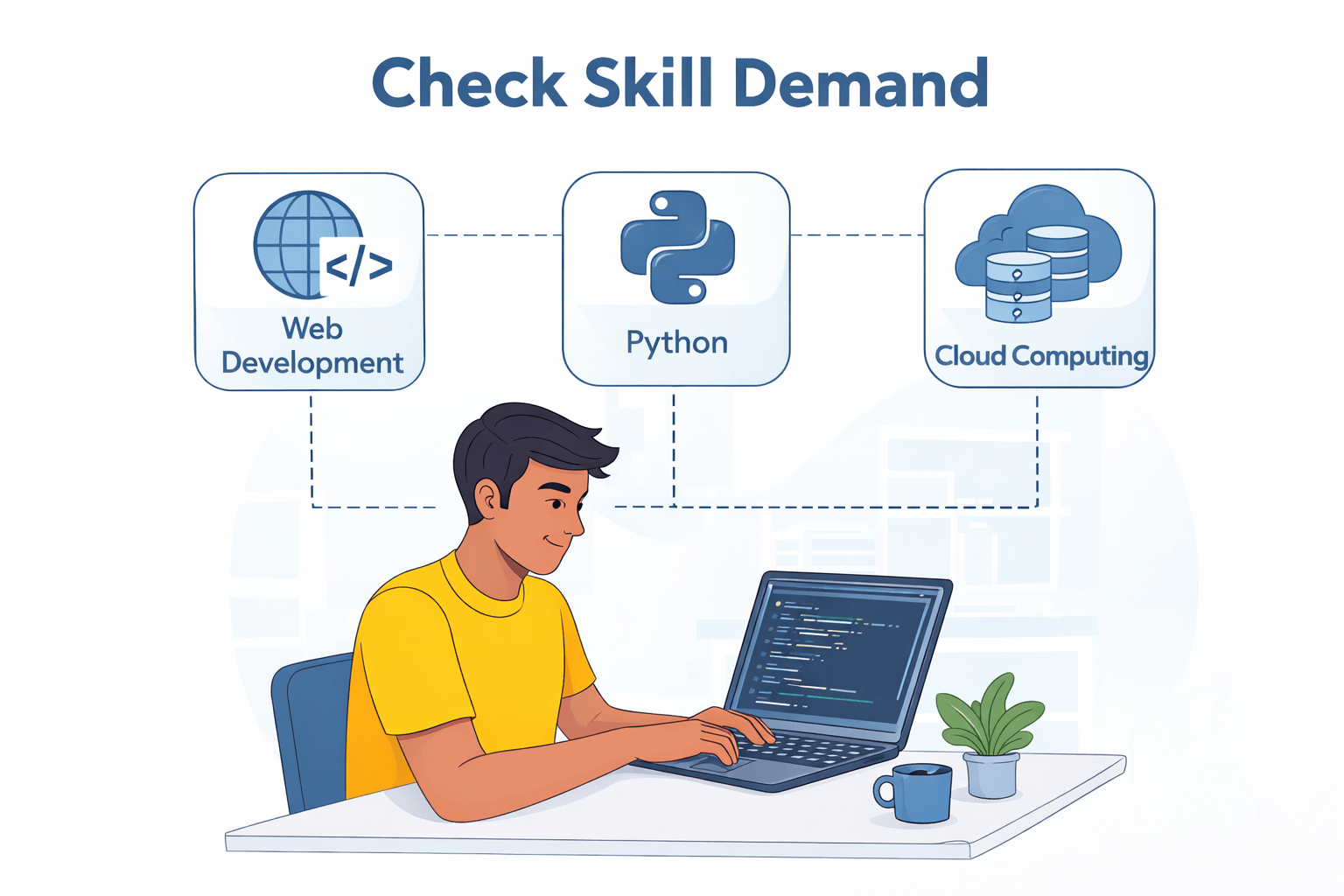
In India, entry-level roles in technology are strongly aligned with certain skill areas. Web development, Python programming, data analysis, cloud basics, and cybersecurity are all consistently in demand. When your topic touches one of these areas in a practical way, it becomes immediately more valuable.
Consider the difference between a topic like cloud computing overview and a topic like deploying a web application on a cloud platform. The first one allows you to explain concepts, but the second one forces you to work with tools, understand deployment, and solve real problems. If you mention the second in an interview, it carries far more weight.
A useful way to think about this is to imagine a recruiter reading your resume. If your seminar topic translates into a skill they recognise, it adds value. If it remains a generic concept, it is easily ignored.
For example, a student who chooses a topic like machine learning algorithms might end up describing definitions and types. Another student who chooses to build a simple prediction model using Python will have something concrete to discuss. The second student is always in a stronger position.
Step 3: Evaluate Difficulty
Choosing the right level of difficulty is where many students struggle. Some pick topics that are too simple, which leads to low learning. Others choose topics that are too complex and end up abandoning them halfway.
The ideal topic sits somewhere in between. It should challenge you enough to learn something new, but not overwhelm you to the point where you cannot complete it.
To judge this properly, you need to be honest about your current skill level. If you have never worked with programming before, selecting a highly advanced machine learning project is likely to create frustration rather than growth. On the other hand, choosing something like basic computer networking concepts may not push you enough.
A better approach is to break the topic into smaller parts and see if it feels manageable. For example, if you are considering a recommendation system, think about what it involves. You might need to learn Python basics, understand simple logic, and implement a small model. If this seems achievable within a few weeks, the topic is reasonable. If it feels like you need months of preparation, it is too ambitious for a seminar.
Another useful strategy is to simplify rather than abandon. Instead of choosing a very advanced topic like deep learning for image recognition, you could work on image classification using a pre-trained model. This allows you to stay within the same domain but reduces complexity significantly.
The goal is not to impress with complexity, but to complete something meaningful.
Step 4: Match with Project Potential
This is the most important step in the entire process. A seminar topic by itself has limited value. Its real power comes from what you can build using it.
When you choose a topic, you should immediately think about whether it can turn into a small project. If the answer is no, the topic is unlikely to help you in your career.
A strong topic naturally leads to something you can demonstrate. This could be a simple web application, a chatbot, a data dashboard, or even a small automation script. The key is that it produces an output you can show.
For instance, consider the difference between studying the concept of the Internet of Things and building a basic home automation system. The first gives you theoretical understanding. The second gives you something you can explain, demonstrate, and even improve over time.
When you sit in an interview, this difference becomes very clear. Instead of saying that you studied IoT, you can explain how you built a system, what challenges you faced, and how you solved them. This shifts the conversation from theory to experience.
A good seminar topic should therefore act as the starting point of a journey. It begins with understanding the concept, moves into building something small, and eventually becomes a talking point in interviews.
Bringing It All Together
When you combine all four steps, the process becomes much clearer.
You start by understanding your goal. This gives direction. You then check whether the topic aligns with real-world skill demand, ensuring relevance. After that, you evaluate whether you can realistically complete it within your time and skill level. Finally, you confirm that it can evolve into a project.
If a topic passes all these stages, it is worth choosing. If it fails at any stage, it is better to reconsider.
A Simple Example
Take a common domain like cybersecurity.
If a student simply chooses cybersecurity as a topic, they may end up preparing a general presentation with definitions and concepts. This does not create much value.
If the same student applies the framework, the outcome changes. They define their goal as getting a job in IT. They check that cybersecurity is a relevant skill area. They then narrow the topic down to something manageable, such as building a password strength checker using Python. Finally, they ensure that this can be implemented as a small project.
Now the seminar is no longer just a presentation. It becomes a practical exercise, a project, and a resume point.
Common Mistakes
One of the most common mistakes is choosing topics based on trends. Just because a field like artificial intelligence is popular does not mean every student should choose it. Without the right level of understanding and execution, it becomes superficial.
Another mistake is copying what seniors have done. Their background, interests, and goals may be completely different from yours. Following their path without thinking often leads to poor outcomes.
Many students also underestimate the importance of practical work. A well-designed project, even if simple, is far more valuable than a complex idea that remains incomplete.
Final Perspective
Your seminar is not just an academic requirement. It is one of the earliest opportunities you get to align your academic work with your career.
When you approach it with a clear goal, awareness of market demand, realistic planning, and a focus on building something, it becomes much more than a presentation. It becomes a stepping stone.
The shift is simple but powerful. Instead of asking what topic should I choose, start asking what outcome do I want from this topic.
Once that question becomes clear, the right choice becomes much easier!
Wish you all the best!