Becoming a software engineer is one of the most common career goals for engineering students in India. However, most students approach it in a fragmented way. They learn a bit of programming, try some tutorials, maybe build a small project, and then start applying for jobs. The problem is not effort, but lack of structure.
If you look closely at job descriptions for software engineer roles in India, whether in service-based companies like TCS and Infosys or product-based companies like Amazon and Flipkart, you will notice a pattern. Companies are not looking for isolated knowledge. They are looking for a combination of skills that work together.
This article breaks down those skills in a practical way and shows you how to build them step by step.
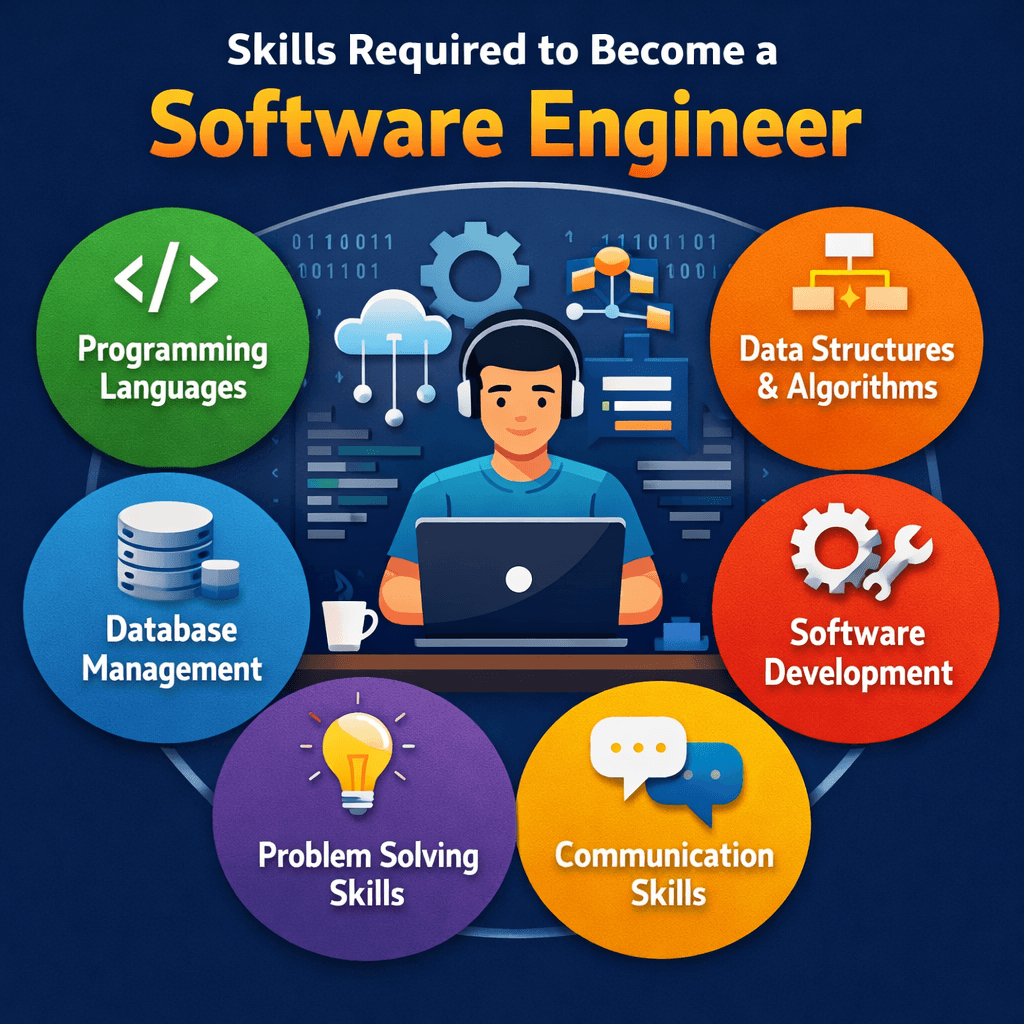
Understanding What Companies Actually Expect
Before talking about skills, it is important to understand what recruiters are evaluating.
A fresher software engineer is not expected to know everything. But they are expected to demonstrate three things clearly. First, they should be able to write correct and efficient code. Second, they should understand how software systems work at a basic level. Third, they should show the ability to learn and solve problems independently.
Everything else builds on top of these expectations.
Core Skill 1: Programming Fundamentals
Programming is the foundation. Without this, nothing else matters.
Many students make the mistake of learning multiple languages without mastering any of them. It is far more effective to pick one language, such as Python or Java, and build strong fundamentals.
This includes understanding variables, loops, conditions, functions, and basic data structures. But more importantly, it includes the ability to think logically and translate a problem into code.
For example, if you are asked to find duplicate elements in an array, the interviewer is not testing whether you have seen the exact question before. They are testing whether you can break down the problem, think through possible approaches, and implement a solution.
A practical way to build this skill is to solve small problems daily. Instead of passively watching tutorials, you should actively write code. Platforms like coding practice websites can help, but even simple self-created problems are effective.
The key is consistency. Even one hour of focused coding daily is enough to build strong fundamentals over time.
Core Skill 2: Data Structures and Algorithms
Once you are comfortable with basic programming, the next layer is data structures and algorithms. This is one of the most important areas for software engineer interview preparation.
In India, almost every technical interview for freshers includes questions on arrays, strings, linked lists, stacks, queues, and basic algorithms like searching and sorting.
But the goal is not to memorise solutions. The goal is to understand how different approaches affect performance.
For example, consider searching for an element in a list. A simple approach is to check each element individually. This works, but it is slow for large data. A more efficient approach like binary search works much faster, but only if the data is sorted.
Understanding these trade-offs is what interviewers are looking for.
A practical strategy is to focus on one topic at a time. Spend a few days understanding arrays, then move to strings, and so on. For each topic, solve multiple problems of increasing difficulty. Over time, patterns will start becoming clear.
Core Skill 3: Understanding of Software Development
Knowing how to code is important, but software engineering is more than just writing code.
You need to understand how software is built, tested, and maintained.
This includes basic knowledge of version control systems like Git, understanding how code is organised into modules, and how different parts of an application interact with each other.
For example, if you are building a simple web application, you should understand how the frontend communicates with the backend, how data is stored in a database, and how the entire system is deployed.
Even at a beginner level, having this understanding sets you apart. It shows that you are thinking like an engineer, not just a coder.
Core Skill 4: Problem-Solving Ability
Problem-solving is a skill that cuts across all technical areas.
In interviews, you will often be given a problem that you have not seen before. Your ability to approach it logically is more important than getting the perfect answer.
For example, you might be asked to design a system that handles user login. You need to think about how users are authenticated, how passwords are stored securely, and how errors are handled.
The process of thinking, explaining your approach, and refining it based on feedback is what interviewers observe.
To improve this skill, you should practice thinking aloud while solving problems. Even when you are coding alone, try to explain your logic as if you are speaking to someone. This builds clarity and confidence.
Core Skill 5: Project Building and Practical Implementation
This is where most students fall short.
They learn concepts but do not apply them in real scenarios. As a result, they struggle to explain their knowledge during interviews.
Building projects bridges this gap.
A good project does not have to be complex. It should solve a simple problem and demonstrate your understanding.
For example, building a task management application can help you understand user input, data storage, and basic interface design. Adding features like user authentication or notifications can further enhance it.
What matters is not the number of projects, but the depth of understanding. You should be able to explain why you chose a particular approach, what challenges you faced, and how you solved them.
This is what makes your project valuable in a resume.
Core Skill 6: Database and Backend Basics
Most real-world applications involve storing and retrieving data.
Understanding how databases work is therefore essential. You should know how to design simple tables, write basic queries, and understand concepts like primary keys and relationships.
For example, if you are building a student management system, you should be able to design a database that stores student details, courses, and results in a structured way.
Even basic knowledge of backend development, such as handling requests and responses, adds significant value. It shows that you understand how applications work beyond the surface level.
Core Skill 7: Communication and Clarity
Technical skills alone are not enough.
You must be able to explain your thoughts clearly. In interviews, this often makes the difference between selection and rejection.
When you describe a project, avoid vague statements. Instead of saying you worked on a web application, explain what problem it solves, how it works, and what technologies you used.
Clarity in communication reflects clarity in thinking.
Core Skill 8: Consistency and Learning Discipline
One of the most underrated skills is consistency.
Many students start learning with enthusiasm but lose momentum after a few weeks. Software engineering requires continuous learning.
Technologies change, tools evolve, and new concepts emerge. The ability to learn consistently over time is what sustains your career.
A simple approach is to create a daily or weekly plan. Allocate time for coding, problem solving, and project work. Even small, consistent efforts lead to significant progress.
A Practical Roadmap
To bring everything together, you can follow a structured path.
Start with one programming language and build strong fundamentals. Once you are comfortable, move into data structures and algorithms. At the same time, begin working on small projects.
As you progress, add layers like database knowledge and basic system understanding. Throughout this process, keep practising problem-solving and improving your communication.
Over a period of three to six months, this structured approach can make you job-ready for entry-level software engineer roles.
Final Perspective
The journey to becoming a software engineer is not about collecting random skills. It is about building a strong foundation and layering it with practical experience.
If you focus on programming, problem solving, system understanding, and project building, you will naturally align with what companies are looking for.
The key is to move from passive learning to active implementation. Instead of asking what skills are required, start asking how you can build and demonstrate those skills.
That shift in approach is what turns an engineering student into a software engineer.