The newly launched MacBook Neo (2026) is Apple’s most affordable MacBook, designed specifically to bring premium computing into a budget-friendly segment. Starting around ₹69,900 in India, it targets students who need a balance of performance, portability, and ecosystem integration.
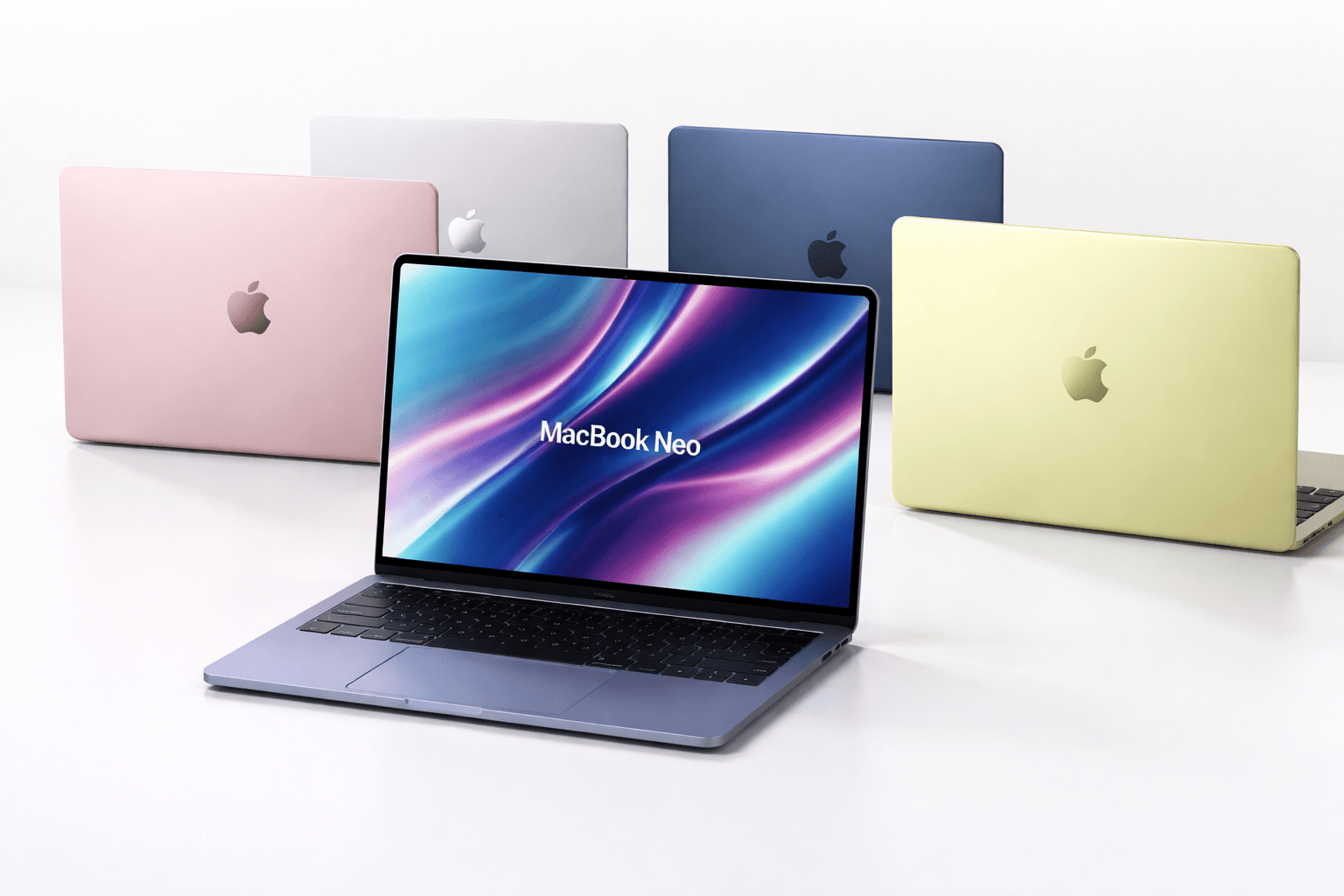
Unlike traditional MacBooks powered by M-series chips, the MacBook Neo uses the A18 Pro system-on-chip, originally designed for high-performance mobile computing. This architecture enables efficient processing, low power consumption, and integrated AI acceleration making it highly suitable for engineering college or academic workloads such as coding, research, and multimedia tasks.
Technical Specifications (Accurate Overview)
- Processor: Apple A18 Pro (6-core CPU: 2 performance + 4 efficiency cores)
- GPU: 5-core integrated GPU
- Neural Engine: 16-core AI processor
- Memory: 8GB unified memory
- Storage: 256GB / 512GB SSD
- Display: 13-inch Liquid Retina (2408 × 1506, 500 nits brightness)
- Battery Life: Up to 16 hours
- Weight: Approx. 1.23 kg
- Ports: USB-C (USB 3 + USB 2), headphone jack
- Connectivity: Wi-Fi 6E, Bluetooth 6
- Camera: 1080p FaceTime HD
- Design: Fanless aluminium body (silent operation)
Portability
Portability is one of the strongest advantages of the MacBook Neo for Indian students who travel daily via buses, trains, or bikes. With a lightweight design of approximately 1.23 kg and compact 13-inch form factor, it fits easily into backpacks without adding significant load.
From a technical perspective, the use of the A18 Pro low-power SoC allows Apple to implement a fanless thermal architecture, reducing both weight and thickness. This also eliminates mechanical noise, making it ideal for classrooms, libraries, and study environments.
For students attending long lectures or moving between hostels and campus buildings, such portability ensures convenience and consistent usability.
A18 Pro system-on-chip (SoC), is it good for multi-tasking?
The A18 Pro system-on-chip (SoC) enables highly efficient multitasking through its heterogeneous 6-core CPU architecture, combining 2 performance cores and 4 efficiency cores for dynamic workload distribution. Using an advanced QoS-aware scheduler in macOS, tasks are prioritised and executed with minimal latency, ensuring smooth foreground performance while background processes run efficiently. Its Unified Memory Architecture (UMA) allows CPU, GPU, and Neural Engine to share a single high-bandwidth memory pool, eliminating data duplication and reducing bottlenecks. The integrated GPU handles parallel workloads such as UI rendering and compute acceleration, while the 16-core Neural Engine isolates AI tasks like machine learning inference. Additionally, memory compression and fast SSD-based swap management maintain system responsiveness under heavy loads, making the A18 Pro highly optimised for concurrent applications and academic multitasking scenarios.
Battery
Battery performance is crucial in Indian academic settings where charging points may not always be accessible. The MacBook Neo offers up to 16 hours of battery life on a single charge, enabling all-day usage.
The efficiency comes from the heterogeneous CPU architecture, where efficiency cores handle lightweight tasks like browsing and note-taking, while performance cores activate only when needed. This dynamic workload distribution significantly reduces energy consumption.
Additionally, the optimisation between macOS and Apple silicon ensures minimal background power drain. For students, this means uninterrupted classes, lab sessions, and project work without constantly worrying about charging.
Seamless Sync with iPhone
The MacBook Neo integrates deeply with the Apple ecosystem, especially the iPhone, offering a seamless cross-device experience. Through Apple’s Continuity features, students can:
- Transfer files instantly using AirDrop
- Continue tasks using Handoff
- Sync notes, photos, and documents via iCloud
- Use iMessage and FaceTime directly on the laptop
This integration is powered by Wi-Fi 6E, Bluetooth 6, and cloud-based synchronisation frameworks, ensuring low-latency communication between devices.
For Indian students who rely heavily on smartphones for communication and academic coordination, this ecosystem reduces friction and improves productivity.
AI Project Research
The MacBook Neo is particularly beneficial for students working on Artificial Intelligence, Machine Learning, and data-driven projects. It includes a 16-core Neural Engine, specifically designed for accelerating AI computations.
This hardware enables efficient execution of tasks such as:
- Image recognition
- Natural language processing
- Predictive modelling
The unified memory architecture ensures that CPU, GPU, and Neural Engine share the same memory pool, reducing latency and improving data throughput.
Additionally, Apple provides on-device AI features for summarising notes and assisting with academic workflows, which is highly useful for research-oriented students.
For Indian engineering students, this means the ability to run AI models locally without depending entirely on expensive cloud services.
Conclusion
The MacBook Neo is a well-balanced device tailored for Indian college students. With its efficient A18 Pro chip, long battery life, lightweight design, and strong AI capabilities, it addresses the core academic requirements of modern learners.
Its seamless integration with the Apple ecosystem further enhances productivity, making it an excellent choice for students pursuing engineering, research, and creative disciplines. While it is an entry-level MacBook, its technological capabilities make it a powerful and future-ready academic tool.