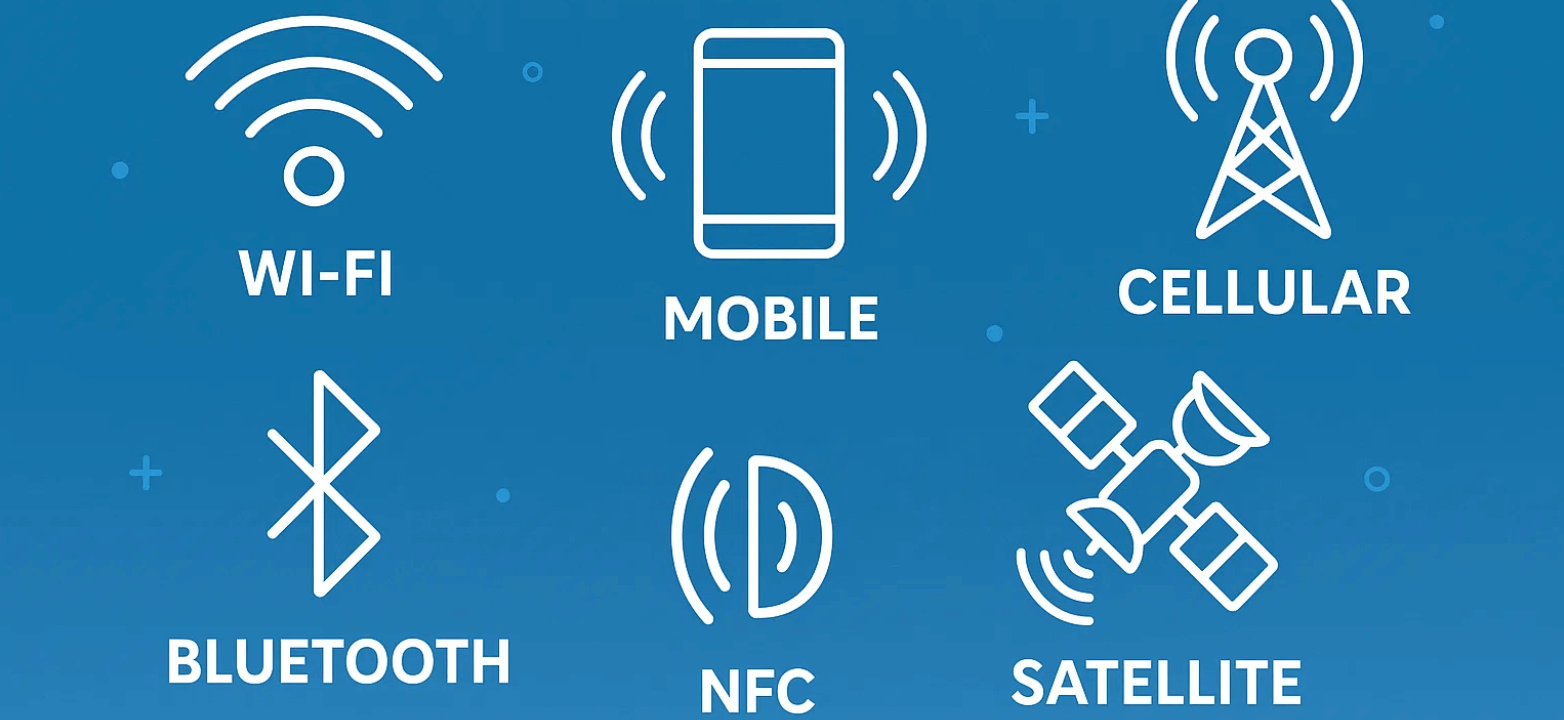
Advanced wireless communication technologies have become essential to our daily lives, transforming how we connect, communicate and share information. New advancements such as 5G, Wi-Fi 6, and Bluetooth have radically improved data transfer speeds, reduced latency and expanded network capacity, leading to faster and seamless internet connectivity. These technologies have enabled high-quality video streaming, real-time gaming, and efficient file transfers. The reliability of wireless networks has also made it possible to connect smart devices, enabling greater automation and control through the Internet of Things (IoT). In addition, advanced wireless communication technologies have revolutionised healthcare by allowing remote patient monitoring and telemedicine. They have also made collaboration in the business world more efficient through video conferencing and cloud-based applications. Overall, these technological advancements have not only made our daily tasks more convenient but also driven innovation across various industries, making a significant impact on the way we live and work.
Advanced Wireless Communications Technologies – 2025
1. Terahertz (THz) Communication
Terahertz waves (0.1–10 THz) are being explored for ultra-high-speed wireless communication. With the potential to deliver data rates exceeding 100 Gbps, THz is expected to be pivotal for 6G and applications such as real-time holography, quantum networking, and massive-scale sensor networks. -> Terahertz (THz) Communication
2. Reconfigurable Intelligent Surfaces (RIS)
RIS involves smart surfaces embedded with passive or active elements that dynamically manipulate electromagnetic waves. These surfaces enhance signal strength, reduce interference, and improve coverage in urban and indoor environments, becoming crucial for next-gen smart infrastructure.
3. AI-Native Wireless Networks
Unlike earlier use of AI as an add-on, AI-native wireless networks integrate artificial intelligence into the network’s core design, enabling autonomous optimisation, predictive maintenance, and dynamic spectrum allocation. These self-learning systems are expected to significantly reduce operational complexity.
4. Non-Terrestrial Networks (NTN) Integration
Beyond traditional satellite systems, NTNs in 2025 include High-Altitude Platform Stations (HAPS) and unmanned aerial vehicles (UAVs). These networks complement terrestrial 5G and future 6G, extending coverage in rural, maritime, and disaster-prone areas.
5. Full Duplex Wireless Communication
Conventional systems transmit and receive on separate channels or timeslots. Full duplex allows simultaneous transmission and reception on the same frequency, potentially doubling spectral efficiency. Key breakthroughs in self-interference cancellation are making this increasingly viable in real-world deployments.
6. Quantum Key Distribution (QKD) over Wireless
With rising concerns over data security, wireless QKD is gaining traction. It enables unbreakable encryption based on principles of quantum mechanics. Integrating QKD with mobile networks provides next-generation secure communication for critical applications like defence, banking, and healthcare.
7. Integrated Sensing and Communication (ISAC)
ISAC technologies combine wireless communication with radar sensing on a unified platform. This fusion enables real-time environmental awareness, especially relevant for autonomous driving, industrial automation, and public safety systems.
8. Spectrum Sharing via Dynamic Spectrum Access (DSA)
With spectrum scarcity, DSA enables more efficient use of available frequencies by dynamically allocating underutilised bands across users and services. Regulatory bodies are pushing toward flexible licensing models to accommodate DSA at scale.
9. B5G (Beyond 5G) Ultra-Reliable Low-Latency Communication (URLLC+)
Building on 5G URLLC, URLLC+ technologies in B5G systems promise sub-millisecond latency and enhanced reliability, supporting time-critical use cases like telesurgery, synchronised robotics, and immersive XR.
10. Open Radio Access Network (Open RAN) Evolution
In 2025, Open RAN architectures are maturing, promoting vendor-neutral, software-driven radio access networks. They allow greater interoperability, lower costs, and faster innovation, which is especially beneficial for private and rural networks.
Advanced Wireless Communications Technologies (2024)
Here is a list of the latest and Advanced Wireless Communication technologies.
- 5G (Fifth Generation) : 5G technology represents the latest standard in mobile communication, offering faster data speeds, lower latency, and increased capacity compared to its predecessor, 4G. It enables a wide range of applications, including the Internet of Things (IoT), augmented reality (AR), and virtual reality (VR).
- Wi-Fi 6 (802.11ax) : Wi-Fi 6 is the latest iteration of the Wi-Fi standard, providing improved performance in crowded environments, increased data rates, and enhanced energy efficiency. It is designed to handle a growing number of connected devices.
- 6G Technology : Though still in the early stages of development, researchers and industry experts are already exploring the potential features of 6G. Expected to be available around the end of the 2020s, 6G is anticipated to offer even faster data speeds, extremely low latency, and support for advanced applications such as holographic communications and advanced AI. Related: 6G Network Technology
- Millimetre Wave (mmWave) Communication: Millimetre-wave frequencies in the range of 24 GHz and above are being explored for high-speed, short-range communication. These frequencies enable large bandwidths, making them suitable for high-speed wireless broadband and next-gen wireless backhaul applications.
- Massive MIMO (Multiple Input, Multiple Output): Massive MIMO involves using a large number of antennas at base stations to improve the spectral efficiency and capacity of wireless communication systems. It is a key technology in 5G networks and can enhance network performance.
- Edge Computing for Wireless Networks: Edge computing involves processing data closer to the source of data generation, reducing latency and improving response times. In wireless communication, edge computing can enhance the performance of applications like autonomous vehicles, IoT devices, and augmented reality.
- Software-Defined Networking (SDN) and Network Function Virtualization (NFV): These technologies enable more flexible and programmable network architectures. SDN allows for dynamic network configuration, while NFV allows virtualization of network functions, leading to more efficient use of resources.
- Visible Light Communication (VLC): VLC uses visible light for communication, potentially offering high data rates. It has applications in scenarios where radio frequency communication may be restricted, such as in aircraft cabins and hospitals.
- Satellite Internet: Companies are working on deploying satellite constellations to provide global broadband internet coverage. These low Earth orbit (LEO) satellite networks aim to offer high-speed internet access to underserved or remote areas.
Related:
- Electronics and Communication Engineering(ECE) Seminar Topics 2024
- ECE Seminar Topics 2024 – The Top 100 Topics
Collegelib.com prepared and published this curated seminar topic ideas for Advanced Wireless Communications Technologies Students. Before shortlisting your topic, you should do your research in addition to this information. Please include Reference: Collegelib.com and link back to Collegelib in your work.