Introduction
The term Industry 4.0 refers to the fourth industrial revolution — a paradigm shift in manufacturing and industrial practice driven by the integration of digital technologies into physical production systems. Unlike earlier revolutions led by mechanisation, mass production, and computing, Industry 4.0 leverages interconnected technologies such as the Internet of Things (IoT), Artificial Intelligence (AI), cyber‑physical systems and big data analytics to create intelligent, responsive, and adaptive production environments.
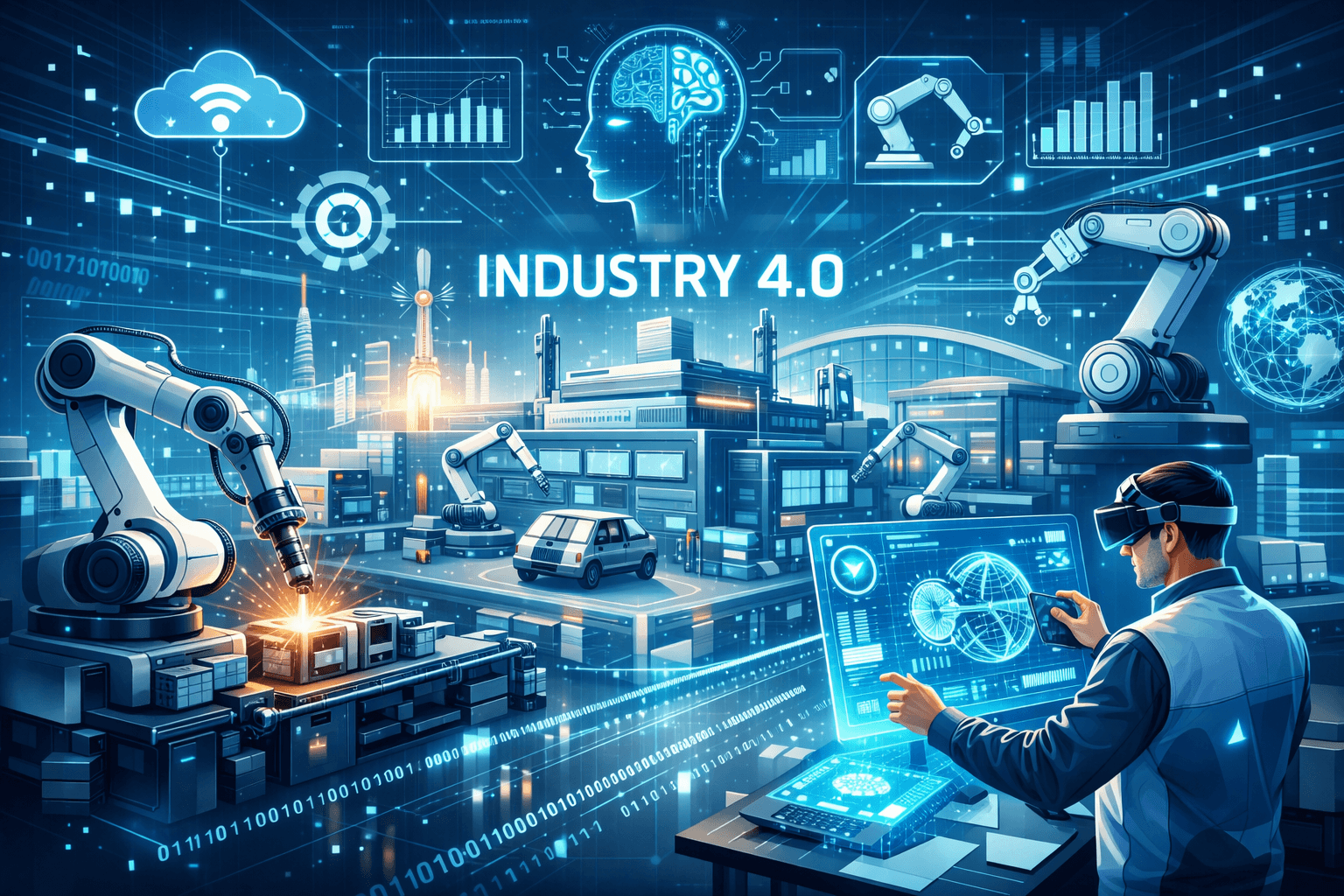
Industry 4.0 is not merely a buzzword but a practical reality today. It has profound implications for productivity, competitiveness, and sustainability across industries — from automotive and heavy machinery to pharmaceuticals and consumer goods. In India, government initiatives and industrial collaborations further reflect the nation’s commitment to adopting these advanced practices.
Core Technologies of Industry 4.0
Industry 4.0 represents a synthesis of multiple advanced technologies that collectively enable smarter, more efficient, and adaptive manufacturing systems.
1. Internet of Things (IoT)
IoT forms the backbone of Industry 4.0. Sensors embedded in machines, tools, and infrastructure continuously collect data on parameters like temperature, vibration, throughput, and energy usage. These interconnected devices communicate in real time, allowing managers to monitor processes without being physically present on the shop floor.
2. Artificial Intelligence (AI) and Machine Learning
AI processes vast amounts of sensor and operational data to derive actionable insights. Machine learning models predict equipment failures before they occur, optimise production schedules, and automate decision‑making across the value chain. These capabilities reduce waste and enhance quality.
3. Cyber‑Physical Systems & Digital Twins
A cyber‑physical system tightly blends the physical and digital worlds. For instance, a digital twin — a virtual replica of a physical asset — can simulate performance, test scenarios and optimise processes before making changes in the real factory. This reduces trial‑and‑error on the production floor and supports rapid innovation.
4. Data Analytics and Cloud Computing
Cloud platforms store and process massive datasets generated by connected devices. Advanced analytics extract trends and patterns that inform strategic decisions. Cloud‑based systems also facilitate collaboration between different sites and stakeholders.
5. Robotics and Automation
Modern robots — often equipped with advanced sensors and AI — perform complex, repetitive, and hazardous tasks with precision. Collaborative robots (cobots) work alongside humans, enhancing productivity while maintaining safety.
Industry Practice: How Industry 4.0 Works on the Ground
Adopting Industry 4.0 technologies transforms traditional factories into smart manufacturing units — highly connected, data‑driven, and self‑optimising ecosystems. These changes are tangible and reflect in real practice.
1. Smart Factories
Smart factories are the hallmark of Industry 4.0. Such facilities integrate IoT devices, machine‑learning algorithms, cloud systems and robotics to create an ecosystem that continuously learns and adapts. In these environments, machines self‑diagnose issues, production processes adjust dynamically and quality checks are automated.
2. Predictive Maintenance
Instead of performing maintenance after a breakdown, sensors monitor machine health in real time. Data analytics models identify early signs of wear or failure, prompting timely intervention. This reduces unplanned downtime, extends equipment life and lowers maintenance costs — a major benefit for manufacturers.
3. Digital Supply Chains
Industry 4.0 blurs the line between production and supply chain management. Real‑time data flows from suppliers, manufacturers, and distributors, enabling coordinated decision‑making. For example, inventory systems can automatically trigger production or delivery orders when stock falls below defined levels, reducing delays and stock‑outs.
4. Customisation and Flexibility
Traditional mass‑production lines struggle with small, customised batches. Under Industry 4.0, digitalised systems quickly reconfigure production lines to handle diverse product specifications without significant downtime, enabling manufacturers to meet individual customer demands efficiently.
Real‑World Examples
Several global and Indian companies have already embraced Industry 4.0 principles.
1. Siemens Amberg Plant
Siemens’ Amberg electronics plant in Germany is one of the most cited examples of smart manufacturing. Connected systems gather data from every machine and component, enabling precise control, real‑time performance monitoring, and continuous improvement of quality and output.
2. Tata Steel
In India, Tata Steel has implemented IoT integration, automation and data analytics across its operations. These technologies help optimise energy use, track material flow and enhance process control, demonstrating how Indian heavy industries can adopt modern manufacturing practices.
3. Xiaomi’s Automated Factory
Xiaomi’s fully automated manufacturing facility uses AI, IoT, and advanced robotics to achieve round‑the‑clock production with minimal human intervention — delivering high productivity and consistency.
Benefits of Industry 4.0 in Practice
Industry 4.0 delivers a wide range of advantages when implemented effectively.
1. Enhanced Productivity and Efficiency
Connected systems reduce idle time, automate repetitive tasks and optimise resource use, increasing overall productivity. Predictive maintenance and real‑time monitoring minimise unplanned downtime and maximise operational uptime.
2. Quality and Customisation
AI‑driven process control and real‑time data analytics improve product quality and consistency. Smart factories can adapt quickly to variations in design or production requirements, enabling mass‑customised manufacturing.
3. Cost Savings
Although initial implementation costs can be high, long‑term savings arise from reduced waste, improved asset utilisation, and fewer unplanned breakdowns. Moreover, data‑driven decisions help streamline operations and reduce operational expenses.
4. Sustainability
Industry 4.0 systems improve energy efficiency by optimising machine usage, reducing emissions and minimising waste. IoT sensors help manage utilities smartly — aligning production with environmental goals.
Challenges in Adopting Industry 4.0
Despite the benefits, organisations face several challenges.
1. Skill and Workforce Transition
Workers need new skills to operate complex digital systems. Upskilling and reskilling are essential to make the workforce industry‑ready. Training centres and industry‑academia collaborations are crucial in addressing this gap.
2. Integration with Legacy Systems
Many factories rely on older equipment that lacks digital interfaces. Integrating these legacy systems with modern digital infrastructure can be complex and costly.
3. Cybersecurity Risks
Increased connectivity can expose systems to cyber threats. Manufacturers must prioritise robust cybersecurity measures to protect sensitive data and operational integrity.
Conclusion
Industry 4.0 is far more than a set of technologies — it is a transformative approach to industrial practice that redefines manufacturing and business operations. It connects machines, data and people, turning traditional factories into intelligent, adaptive and efficient production environments. As companies in India and across the globe continue to adopt these technologies, manufacturing will become more productive, sustainable and responsive to customer needs.
While challenges remain, the potential benefits of Industry 4.0 make it a cornerstone of modern engineering practice and industrial competitiveness in the 21st century.
This article explores Industry 4.0, detailing its core technologies, real-world applications, benefits, and challenges in transforming modern industrial practices.
Reference: https://en.wikipedia.org/wiki/Fourth_Industrial_Revolution