Introduction
Hydrogen is increasingly being recognised as a crucial element in India’s clean energy transition, particularly for the transportation and industrial sectors. With rising concerns over climate change, energy security, and fossil fuel dependency, hydrogen offers a zero-emission alternative when produced using renewable energy. Designing a robust hydrogen refuelling infrastructure across India is therefore essential to support the adoption of hydrogen-powered vehicles and to realise the nation’s long-term sustainability goals.
Related: Hydrogen-Based Mechanical Energy Systems
Overview of Hydrogen Refuelling Infrastructure
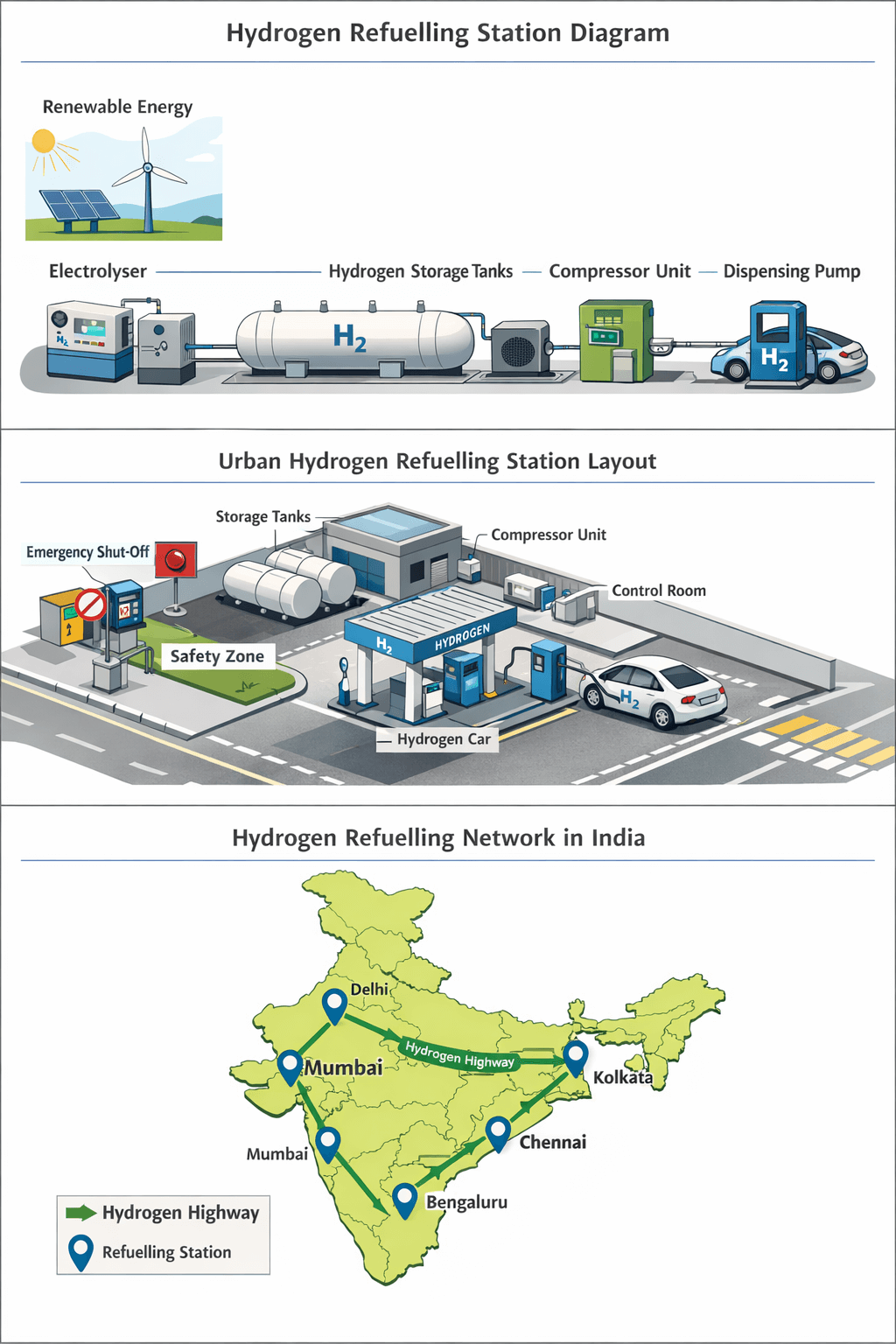
Hydrogen refuelling infrastructure consists of facilities that produce, store, compress, transport, and dispense hydrogen fuel to vehicles. Unlike conventional petrol or diesel stations, hydrogen stations require advanced systems due to hydrogen’s low density, high diffusivity, and flammability. In the Indian context, these stations are being developed primarily as green hydrogen units, where hydrogen is generated using electrolysers powered by renewable energy sources such as solar and wind.
Policy Framework and National Initiatives
The Government of India has laid strong emphasis on hydrogen development through national-level missions and policy frameworks. These initiatives aim to create hydrogen production hubs, pilot hydrogen mobility projects, and refuelling corridors connecting major industrial and transport routes. Such policy backing provides direction for infrastructure design, encourages private investment, and supports standardisation of safety and operational norms across the country.
Design Considerations for Indian Conditions
Designing hydrogen refuelling infrastructure for India requires careful consideration of geographical diversity, climate conditions, and urban density. Stations must be capable of operating in extreme temperatures, from coastal humidity to cold Himalayan regions. Safety is a top priority, with designs incorporating leak detection systems, pressure relief mechanisms, and adequate ventilation to prevent hydrogen accumulation.
Space optimisation is another important factor, especially in congested urban areas where land availability is limited. Modular and compact station designs are being explored to integrate hydrogen refuelling within existing fuel stations or transport depots.
Challenges in Nationwide Deployment
One of the major challenges in deploying hydrogen refuelling infrastructure across India is the high initial capital cost. Electrolysers, high-pressure storage tanks, and safety systems significantly increase investment requirements. Additionally, the current low number of hydrogen-powered vehicles leads to uncertainty in demand, creating hesitation among investors.
Hydrogen distribution also presents difficulties, as transporting hydrogen over long distances requires specialised pipelines or high-pressure tankers. This makes decentralised production near refuelling stations a preferred approach, though it adds complexity to station design and operation.
Future Outlook and Opportunities
Despite these challenges, the future outlook for hydrogen refuelling infrastructure in India is promising. Rapid expansion of renewable energy capacity is expected to reduce the cost of green hydrogen production. Technological advancements in storage, compression, and safety systems will further improve feasibility and reliability.
Collaboration between government agencies, public sector units, private companies, and research institutions will play a key role in scaling infrastructure. Over time, hydrogen refuelling stations could become as common as conventional fuel stations, especially along freight corridors and in major cities.
Conclusion
Hydrogen refuelling infrastructure design in India is still in its early stages but shows strong potential to support a cleaner and more sustainable energy future. With supportive policies, thoughtful engineering design, and continued innovation, hydrogen can become a viable alternative fuel for transport and industry. Addressing cost, safety, and distribution challenges will be critical in transforming hydrogen infrastructure from pilot projects into a nationwide reality.